
Friday, April 12, 2024


Saturday, March 30, 2024
Tuesday, March 19, 2024
Haibun: The Joy and Journey of Poetic Engineering By Pravat Kumar Padhy; Café Haiku, 19 th January to 23 February 2024 Part 1 to Part 6

By Pravat Kumar Padhy
Historical Perspective
The literary
practice of writing mixed verse and prose is originated in Japan way back
during the 8th century. The Man’yōshū, the first major
anthology of Japanese poetry that appeared in c. 780 contains the first tanka
prose (prose with waka poetry). Perhaps the first novel
in world literature, Murasaki Shikibu’s The Tale of Genji (c.
1000), is the first novel interlacing fictional prose with poetry. In the early 12th century, the word “prosimetrum”
(prosa : prose and metrum:verse) is associated with the Rationes
dictandi of Hugh of Bologna. Boethius’ Consolation of Philosophy (c.
524), Snorri Sturluson’s Heimskringla (c. 1230), Dante’s La Vita
Nuova (c. 1295), The Voyage of Bran (c. 800) , Sweeney’s
Frenzy (c. 1300) and texts of
the Old Irish and Middle Irish traditions are some of the
historical examples of literature synthesizing
prose with poetry.
The composition Champu or Chapu-Kavya, a
combination of poetry and prose, has been found in ancient Indian
literature during the Vedic period (c. 1500 –
c. 500 BCE) consisting of prose
episodes (Gadya-Kavya) and poetry passages (Padya-Kavya), with
verses interspersed within the prose sections.
The genre of intermixing of prose and poetry is classified by
J. Zimmerman as the “classical” era (prior to
1600); the “modern” era (approximately 1600 to 2000); and the “contemporary”
era there after. Yama no I (The Mountain Well),1647
or 1648 is book of short essays written
in haikai style. Kitamura Kigin’s (1624-1705) short essay text, “Fireflies’ is
written in a beautiful way with a haiku at the end.
Initially
mixing of prose with poetry has been depicted in the form of diaries with waka
(presently known as tanka) poetry. Tanka prose, a practice of writing mixed
verse and prose, originated in Japan way back in the 8th century. The Man’yōshū, the first major
anthology of Japanese poetry that appeared in c. 780 contains the first tanka
prose. The
9th century Manyōshū, “An Excursion to Matsura River,” by
Ōtomo no Tabito, is one of the brilliant literary works of this genre. Texts of poem-tales (uta monogatori) and diaries (nikki)
were penned largely by women in Japanese, while men of the Imperial court were
still using the Chinese language.
Izumi Shikibu’s Diary or Izumi Shikibu Monogatari (The Tales of Izumi Shikibu)
about love, passion, and lamentation is written with prose along with waka
poetry.
https://www.worldhistory.org/Izumi_Shikibu/
World
History encyclopedia on Izumi Shikibu quotes:
“The diary of Izumi Shikibu, known in Japanese as the Izumi
Shikibu Nikki and perhaps written in 1004 CE, is really not a diary
at all but rather a series of memories and episodes. Written in the third
person, the author refers to herself throughout as onna or
'the woman'…..
Izumi had had an
affair with Atsumichi's older brother Prince Tametaka (977-1002 CE), a
relationship which seems to have ended her own first marriage. The affair ended
with Tametaka's death, aged only 26, and Izumi was not to have much luck with
his brother either for he died in 1007 CE. Here is a sample extract from the
diary, illustrating the typical insertion of poems which often appear in pairs,
one as a reply to the other:”
https://www.worldhistory.org/Izumi_Shikibu/
Wallace, J.R. "Reading the Rhetoric of Seduction in Izumi
Shikibu nikki." Havard Journal of Asiatic Studies, Vol. 58,
No. 2 (Dec., 1998), pp. 481-512.
The Prince had come in his usual
secret way. Onna, thinking it unlikely that he would come and, wearied from the
recent religious ceremonies, was dozing, so when there was a knock at the gate
there was no one who might notice the sound. His Highness had heard various
rumors and, surmising that another man might be inside, noiselessly retired and
the next day there was:
While standing
before the wooden door
that was not opened
I experienced
a cruel heart.
So this is what it is like to be
wretched, I now know. Look at my pitiful state. "It appears that His
Highness did announce himself last night! How heartless it was for me to be
sleeping!" she thought. She replied,
How can you 'experience'
whether or not
that 'heart is cruel'?
You just left untouched
my 'wooden door'.
(Wallace, 19)
Tanka prose
in Japanese literature saw the waka enshrined within the prose, an
approach called the “lapidary style.” Tale of the Bamboo Cutter (Taketori
monogatari) is a fairytale-like composition of the 9th
century. Nun
Abutsu in her travel diary “Diary of the
Sixteenth Night Moon” (Izayoi nikki, ca. 1283) writes choka, using the crane
as a metaphor for deep maternal love.
The
ninth century poet Ariwara no Narihira wrote many stories (today we might call them
flash fiction) with waka poems.
Two
iconic literary works during the 10th century are the anonymous Ise monogatari Contes d’Ise Tales
of Ise (includes 143 anecdotes and tales interspersed with 209 waka) and Ki no
Tsurayuki’s Tosa Nikki – Le Journal de Tosa (Tosa Diary ), a travelogue
in diary form written around 935 in kana script. Tosa Diary is based on
emotion and grief and the tanka is closely related to prose.
Yamato
Monogatari or The Tales of Yamato is a collection of 173 short stories with waka poetry
about life in the imperial court in the 9th and 10th centuries and was first
completed in 951.
Lady Murasaki
Shikibu’s iconic novel (1100 pages with 54 titled chapters each equivalent to
the Tosa Nikki grouped into six books), “The Tale of Genji”
of the early 11th century contains more than four hundred tanka.
La Vita Nuova (A New Life), a masterpiece on love, contains both
verse and prose written by Dante Alighieri in 1294. Snorri
Sturluson’s Heimskringla, dated back to 1230, is a mix of alliterative
meters, such as drôttkvætt and prose narrative.
Heike
Monogatari or The Tale of the Heike is a major literary work that
appeared in the mid- thirteenth century interspersed with Tanka and other
poetry forms within the prose. The Kojiki or Record
of Ancient Matters, completed in 712 is one of the
earliest examples (thirteenth century) of prose and poetry in Japan. Sōgi’s Shirakawa Kikō
(1468 A.D.) is a memorable travel diary.
Concept of Haibun
After a long span, Matsuo Basho
(1644-1694) coined the word ‘Haibun’, a literary expression of poetic prose with
haiku in 1690 in a letter to his disciple Kyorai.
The form existed earlier to the
seventeenth century in the form of prefaces and mini-lyrics, but Basho infused
the aesthetic sense of haiku spirit (aware).
Basho’s ‘Oku no Hosomichi’ (Narrow Road to the Interior) is
considered the masterpiece of haibun in
Japanese literature. It comprises of
narration of the ecstatic beauty through the traverse of 1500 miles over
156 days, mostly on foot, from Edo (modern-day Tokyo) to the northerly interior
region known as Oku.
http://haibuntoday.blogspot.com/2008/03/insideoutside-stanley-pelter-on-haibun.html
Jeffrey
Woodward comments: “Haibun’s
historical provenance is perhaps inseparable from the haikai of Basho and
his school, that is, it made its social debut in the company of haiku.”
Shin hana tsumi (The New Gathering Flowers) by Yosa
Buson (1716-1783); Oraga Haru (My Spring) and Chichi
no shūen nikki (Last Days of My Father) by Kobayashi Issa (1763-1828), Byōshō
rokushaku (Six-foot Sickbed) by
Masaoka Shiki (1867-1902) and Kōshin’an-ki (Notes from Kōshinan’an), Tsukiyo sōshi (Sketches of Moonlit Nights)
both by Kurita Chodō (1749-1814) are
some of the iconic works in haibun literature. Uzuragoromo (Mottled Quail Cloak) by Yokoi Yayū and ‘On Releasing a Sparrow’ by Kawai Chigetsu are some of
the noteworthy Japanese haibun.
The word haibun is also associated
with old genres of memoirs, diaries and travel literature (nikki and kikôbun)
and even referred in the form of a preface, headnotes to hokku with a short
essay written by haikai masters. Kyoriku Morikawa’s Honchō Monzen (“Prose Collection of
Japan”), published in 1706, is considered
the first Japanese anthology of haibun.
Defining
haibun as a cultural symbiosis, Haruo Shirane
says “haikai prose” as a basic definition of haibun, and further writes
that haibun “combined, in unprecedented fashion, Chinese prose genres, Japanese
classical prototypes, and vernacular language and subject matter, thereby
bringing together at least three major cultural axes” (Traces of Dreams,
27).
(Shirane, Haruo. Traces of Dreams: Landscape, Cultural
Memory, and the Poetry of Bashō. Stanford, California: Stanford University
Press, 1998).
https://contemporaryhaibunonline.com/chohtmlarchive/pages144/A_Ross_Narratives.html
The
classical haibun, ‘Ki no Tsurayuki’s The Tosa Diary’ (935):
18th
February, 13th day. At daybreak the rain was gently falling but then it stopped
and we all went to the nearby place for a hot bath. I looked over the sea and
composed the following poem:
the
clouds overhead
look like rippling waves to me;
if the pearl divers were here
“Which is sea, which is sky?”
I’d ask and they’d answer
So,
since it was after the tenth day, the moon was especially beautiful. After all
these days, since I first came on board the ship, I have never worn my striking
bright red costume because I feared I might offend the God of the Sea. Yet . .
.
*****
http://www.bopsecrets.org/gateway/passages/basho-oku.htm
The opening paragraph of Matsuo Bashô’s ‘Oku no
Hosomichi ’ (The Narrow Road to the Interior) has been translated
by many poets. Indeed it is the iconic haibun and the opening part translated
by Cid Corman and Kamaike Susumu is given below:
Oku
no Hosomichi
By Matsuo Bashô
Moon
and sun are passing figures of countless generations, and years coming or going
wanderers too. Drifting life away on a boat or meeting age leading a horse by
the mouth, each day is a journey and the journey itself home. Amongst those of
old were many that perished upon the journey. So — when was it — I, drawn like
blown cloud, couldn’t stop dreaming of roaming, roving the coast up and down,
back at the hut last fall by the river side, sweeping cobwebs off, a year gone
and misty skies of spring returning, yearning to go over the Shirakawa Barrier,
possessed by the wanderlust, at wits’ end, beckoned by Dôsojin, hardly able to
keep my hand to any thing, mending a rip in my momohiki, replacing the
cords in my kasa, shins no sooner burnt with moxa than the moon at
Matsushima rose to mind and how, my former dwelling passed on to someone else
on moving to Sampû’s summer house,
the
grass door too
turning into
a doll’s house
(From
the eight omote) set on a post of the hut.
Translated
by Cid Corman and Kamaike Susumu
(Back Roads to Far Towns, 1968)
https://contemporaryhaibunonline.com/chohtmlarchive/pages144/A_Ross_Narratives.html
Kurita Chodō (1749-1814) was a highly respected poet
in Japan. His ten haibun, based on the stages
of ten-part of moon, in Tsukiyo sōshi (Sketches of Moonlit Nights)
were written from the perspective of
moon as a metaphor of his own life sketch. Out of ten, two are composed
without haiku. Imamura says, “if the haibun itself bears haiku characteristics,
a haiku need not be attached” .(Tr.
Imamura Takeshi and Patricia Lyons,Published by Noma Minako Matsuyama, japan
2013)
https://contemporaryhaibunonline.com/chohtmlarchive/pages104/Article_Zimmerman_AJapanese.html
The Waxing Moon
By Kurita Chodō
(1749-1814)
By the seventh and eighth days, the
moon takes on a lovely shape. As people come and go along a broad street, they
may look familiar, but it is difficult to know for sure. How delightful it is
to exchange glances for no reason at all. At this time, the moon hidden behind
pine needles is especially wonderful.
going out in autumn
it always seems to be
a moonlit night
(Tr. Professor Patricia Lyons)
(The ten Sketches of Moonlit
Nights)
The Waiting-Night Moon
Kurita Chodō (1749-1814)
What a fine name it is, the
Waiting-Night Moon. While pondering whom to visit on the following night, when
the fifteenth day moon will be full, we think of this person and that, and
cannot wait to see them. It is the way of this world of ours that what lies
before us soon will change. How much more elegant to refrain from looking one's
fill of the moon tonight.
(Tr. Professor Patricia Lyons)
(The ten Sketches of Moonlit
Nights)
https://www.graceguts.com/essays/missing-the-moon-haikuless-haibun
Haibun in English
The classic novel Kusamakura, (lit. "Grass
Pillow") by Natsume Soseki (1867-1916), was
published in 1906 and was later translated into English in 1965 by Alan
Turney as The Three Cornered World.The
novel is written in a poetic style with
a haiku.
The haibun in English can be dated back to the '1950s or '1960s
considering the symbiosis of prose and verse of Jack Kerouac or Jack Cain as
the starting point.
Jack Kerouac’s “The Town and the City” (1950) is
classical poetic prose.
Bill
Wyatt in int. with Diana Webb says, “As
far as I am aware, Kerouac didn’t know of the haibun as a genre but many
passages from his prose, for me, certainly fit that mode. (http://haibuntoday.blogspot.com/2008/05/washing-jade-in-muddy-water-bill-wyatt_27.html)
Carolyn Kizer’s “A Month in Summer” was published in Kenyon Review
in 1962. The Canadian writer Jack Cain’s “Paris” (1964) is considered the first formal modern haibun
in English published in the Haiku Society of America book, A Haiku Path.
Gary Snyder’s travel diary, “Passage through India”, written
during the mid-sixties, is one of the memorable modern haibun-like genre. The
work, “Paris” (1964) by the Canadian writer Jack Cain is considered the
first formal modern haibun in English. James Merrill's “Prose of
Departure”, from The Inner Room (1988), is one of the finest
examples of haibun. Poet Maureen Thorson’s “Time
Traveler’s Haibun: 1989 ” is an
interesting poetic creation. Bruce Ross’s “Journey
to the Interior: American Versions of Haibun” (Tuttle) published in 1998 is the first anthology of English-language
haibun. Ken Jones, Ray Rasmussen, Bruce
Ross, Jeffrey
Woodward, Stanley Pelter, Paul Conneally, George Marsh, Patrick Frank, Nobuyuki
Yuasa, John Brandi, Miriam Sagan, Bill Wyatt, William
M. Ramsey, Judson Evans, William J.
Higginson , Patricia Prime, James Norton , Seán O’Connor, Jim
Kacian, Michael
McClintock, Lynne Reese, Jim Norton,
Richard Straw, Robert Wilson, Peter Butler, John Stevenson, Cor van den
Heuvel, Tom Lynch, Eve Kosofsky
Sedgwick, David Cobb, Charles Hansmann
, Janice M.
Bostok, W F Owen, Dru Philippou, Michael Dylan Welch, Ruth Holzer,
Tish Davis, Jeffrey
Harpeng , Diana Webb, Glenn Coats, Owen Bullock,
Rich Youmans and others have contributed a lot to enrich the haibun literature
in English.
The
journal “American Haibun and Haiga (AHH)” was published in 2000 and was renamed
“Contemporary Haibun” and subsequently “Contemporary Haibun Online” (CHO) in
2003. Prior to AHH, Frogpond, Modern Haiku, Lynx Kyso Flash and others
use to publish a few haibun. Haibun Today, a premier journal of haibun and
tanka prose, was founded in 2007 by Jeffrey Woodward. Journals namely Haibun Journals Under the
Basho, Drifting Sands Haibun and a few others publish haibun and related
genres.
There are some prominent literary pieces written
besides Aemericans, namely the New
Zealander Richard von Sturmer’s A Network of Dissolving Threads (1991);
the Russian Alexey Andreyev’s Moyayama, Russian Haiku: A Diary (1997),
the Croatian Vladimir Devide’s Haibun, Words & Pictures (1997);
and the Romanian Ion Codrescu’s A Foreign Guest (1999)
and Mountain Voices (2000).
Makoto
Ueda has written that “a haibun usually (though not necessarily) ends with
haiku. The implication is that a haibun is a perfect prose complement to the
haiku. . . . The word haibun means haiku prose, a prose piece written in the
spirit of haiku. The essential qualities of haiku are seen in the haibun in
their prose equivalents, as it were. A haibun has, for instance, the same sort
of brevity and conciseness as a haiku” (Matsuo Bashō, 121).
(Ueda, Makoto. Matsuo Bashō. Tokyo: Kodansha, 1970,
1982).
Ken
Jones in his Haibun: an introduction writes, “The essential feature is the interplay of haiku and
prose. As with haiku, the “haibun prose” should be concrete and economical,
free from abstraction, crisp, light handed and rich in imagery. The haiku
serves either to intensify the feeling conveyed by the prose or to take the
reader a step beyond it. Either way it provides some kind of shift in the flow
of the prose.” (https://www.kenjoneszen.com/haibun/haibun_an_introduction)
The
prose section, the verse section or haiku and iii) the title comprise the main
components of haibun. Haibun can be a simple one with one paragraph and one
haiku at the end. If haiku is written in the beginning followed by prose , it
is termed as ‘inverted haibun’.The prose
comprises wide topics such as biographical episodes, short stories travel writing,
conversations, personal experiences, etc. Depending on the relative
placement of verse with respect to the prose section, haibun can be classified
as a prose envelope (haibun starts with a prose paragraph followed by haiku and
finally followed by a prose paragraph), verse envelope (starts with a haiku
followed by prose and ending with a haiku) or can be alternating with prose and
verse elements. In such a complex association of the two different elements, it
is prudent to maintain the poetic sentiment, tonal quality and rhythm with
internal comparisons. There are some examples of writing haiku sequence within
the haibun. Sometimes the usages of an epigraph
or short quotation at the beginning of the haibun have been observed. This adds
a special relevance to the prose section and to the haibun at large.
Jeffrey analysing deeply the identity of prose, haiku, prose poem etc opines:
“Haibun is haiku-like prose with or without one or more haiku. “Haiku-like,” of
course, is susceptible to wide interpretation as it is quite subjective, though
in general one might anticipate “haiku-like prose” to avail itself of ellipsis,
paradox, understatement and other qualities familiar to the reader of haiku.”
and emphasises haibun instead “prose accompanied by one or more
haiku.” needs to be
"heightened (or poetic) prose accompanied by one or more haiku.” (http://haibuntoday.blogspot.com/2007/11/jeffrey-woodward-haibun-minus-haiku.html
The title could be imaginative (connotative) or something related to the
essence of the haibun (denotative).
A suitable title can be borrowed from memorable lines by renowned poets or
writers with a note of the relevant source.
The haiku associated with the prose is the cornerstone of
this genre and needs to be imaginative and meaningful with a creative twist of
fulfillment rather than a narrative continuation of prose. The haiku is the
soul of the literary piece. In the art of link-and shift, it dwells as if in
the prose (link), but it has its own shape and sound (shift).
Professor
Nobuyaki Yuasa, in the introduction to his classic translation of Basho’s
Narrow Road, maintains that “the interaction between haiku poetry and haiku
prose is haibun’s greatest merit ...The relationship is like that between the
moon and the earth: each makes the other more beautiful.” (https://contemporaryhaibunonline.com/chohtmlarchive/pages142/Article_Rasmussen_Commentary_Unsaddled.html)
Richard von Sturmer’s A
Network of Dissolving Threads (1991); the Russian Alexey
Andreyev’s Moyayama, Russian Haiku: A Diary (1997), the
Croatian Vladimir Devide’s Haibun, Words & Pictures (1997);
and the Romanian Ion Codrescu’s A Foreign Guest (1999)
and Mountain Voices (2000) have added the historicl
perspective to haibun literature. Jack Kerouac experimented haibun-like narration in novel as
enumerated in his Desolation Angels (1965) that contain prose
segments with relevant haiku. Rod Wilmot Ribs of Dragonfly (1984) is written in
prose style (fiction form) with haiku at
the end of each chapter. D.D. Lliteras’s trilogy of novels (1992-1994) is
written in the haibun form. William Ramsey and Michael McClintock portrays
brilliantly as haibun story tellers. Spring Journey to the Saxon Shore by
David Cobb is a classic haibun consistes fo 5,000-word haibun.
Man tries innovative experimentation out of curiosity and
inner urge in the field of art, culture and science. Over the years,
experimentations, thematic variation, presentation style, subtle interaction of
prose with haiku collaborative experimentation, imagistic style, splitting of
haiku with the art of link and shift added literary values and freshness of this
genre.
Nobel Laureate, Professor Jennifer Doudna says “The more we know, the more we realise
there is to know.” (https://ddsn.com/blog/digital-design-service-technology-quotes/prof-jennifer-doudna.html)
Analysing the haibun literature, it is interesting to see the
way illustrious poets did carry out innovation combination for enlightening the
genre. It
is like flying kites with colours. There has to be a subtle energy to make it
flow like breeze offering reader enough space to revisit again to have the
cathartic experience. In this essay it is
attempted to make a chronological attempt to record the style, language,
texture, poetic symbiosis, rhythm and resonance in haibun literature through
time and gifted as a joy of reading of such a hybrid and pragmatic genre,
Haibun. I feel it is like ‘Poetic Engineering’ in art and culture to arrive at
the best of literary evolution with time. The respective examples have been
cited from the available resources .
(http://www.hsa-haiku.org/meritbookawards/meritbookawards1975.htm)
The following is an excerpt from the work, “Paris”
(1964) by the Canadian writer Jack Cain.
Paris
by Jack
Cain
Lips that
turn from mine.
Poor little one
Whom I pay.
How
insistent this urge that recurs and to which satisfaction brings momentary
rest. I lie on my bed, alone. . . .
There is a
short letter that asks in tones that tear, please, oh please, come home.
In the
cafe’s light
harsh and bright
faces talk.
(Volume
63, a biannual of poetry, October 1964, No. 2, Board of Publications,
University of Waterloo, Waterloo, Ontario, Canada, pages 32-35).
Hybrid Style Haibun (Haiku
with Tanka)
Lynx, a prominent
journal published such type of literary pieces under the editorship of Jane and
Werner Reichhold during 1997–2003. Goldstein (1983) one of the pioneer tanka
writers has also attempted such style. Larry Kimmel’s “Evening Walk” (1996) is
one of the hybrid pieces with alternates prose with tanka and haiku. Linda
Jeannette Ward is remarkable in portraying hybrid genre embedding prose with
both tanka and haiku indicating a transitional phase of some haibun writers to
writing tanka prose. SUE & KIT'S ANGELS by Catherine Mair and Patricia
Prime is one of the memorable hybun mixed with tanka and haiku.
Similarly, Janice M. Bostok used
haiku and in her tanka collection
“Stepping Stone”. Katherine
Samuelowicz’s master piece tanka prose, “MOROCCO MAY 2004” presents a narration with prose poem (no punctuation)
interspersed with a tanka and an emotional haiku at the end.
Stanley
Pelter in “THE SHORT STRAW” and in “a hill blows up” (first
published in & Y Not? in 2006) used both haiku and tanka. In recent past, Suraj Nanu in his tanka prose, “Mother of Sunsets”,
Vicki Miko in “First day” includes both haiku and tanka.
http://haibuntoday.blogspot.com/2007/12/katherine-samuelowicz-morocco-may-2004.html
By Katherine Samuelowicz
high
from a house roof in the kasbah i look at snow covered mountains at a fertile
green oasis neatly separated with a clean chirurgical cut from yellowy brown
desert at kapusta cabbage heads in neat rows among date palms
in Chellah on Roman columns nasze bociany Polish storks
and nasze malwy our hollyhocks against façades of palaces with
their intricate carved wood stucco and tilework i nasze przydrozne
maki and our red poppies among graves of rulers long dead
in Zagora where a road sign proclaims 52 days to Timbuktu (by
camel) a flock of girls runs from school freshly starched school uniforms
bright smiling eyes hair in plaits laughing wanting to know where we’re from
asking for bonbons
i think about my father
my hair in long plaits
walking together
through a pine forest
all things i was to be
silence all eyes on images from Abu Ghraib prison on the TV screen mint tea and
coffee getting cold in my mind’s eye i see a sunny day in Brisbane among
thousands of people
a young girl
in a wheelchair
walking for peace
(first
published in Yellow Moon 16, Summer 2004)
http://haibuntoday.blogspot.com/2007/12/katherine-samuelowicz-his-grandmas.html?m=0
http://haibuntoday.blogspot.com/2007/12/stanley-pelter-hill-blows-up.html
by
Stanley Pelter
as he dozes
pianos in the air
tip sideways
played by black gloved hands
& a white gull
a hill blows up for no apparent reason
the huffpuffs
put another
in its place
(first
published in & Y Not?, 2006)
Micro Haibun
There have been many experiments of
writing micro haibun, one or two lines prose with haiku at the end. The micro
haibun such as North Pasture Framed by
Kitchen Window By Larry Kimmel (2003), A
HOLIDAY (EDWARD H. POTTHAST) by Diana Webb, WITHOUT A DISCLAIMER By Jeffrey
Winke, TO ANSWER FORTHRIGHTLY by Jeffrey
Winke, sunday dinner by Roberta Beary, Food Fair by w.f. owen and others are innovative in their
expressions.
“On
the Buddha Trail” by Geethankjali Rajan (Café Haiku, 2023) comprises four
microhaibun.
The
Pivot by Jeffrey Woodward is a verse envelope haibun with one-line prose.
http://haibuntoday.blogspot.com/2008/06/jeffrey-winke-without-disclaimer.html
JUNE 1, 2008
By Jeffrey Winke
With
the perfection found in carefree abandon, the pair of mismatched cotton socks –
one red, one robin’s egg blue – fit her feisty, fashion-forward sensibility
that no one this close to the muddy Mississippi is ever credited with
possessing, not without a small-print disclaimer as long as a teenage
basketball player’s kitchen-doorway notched growth chart.
she
defines
cute
One-line haibun by Jim Kacian is
unique. He introduced ‘One-bun’ with one-line prose ending with a one-liner
(monoku). Alan Summers, following this idea, introduced ‘Monobun’ with one-line
prose or single-paragraph prose with 3-line haiku.
https://www.thehaikufoundation.org/omeka/files/original/7e0f3dafee3546b56aa7cc773e5803be.pdf
(Where I Leave Off , one-line
haiku and haibun by Jim Kacian)
An electronic version based on the first printing/1e
druk maart 2010, ISBN 978- 94-90607-02-9
Driftwood
By Jim Kacian
its sap leached away carrying the
endless waters, burns now with a noise-
less fire
pleasantly drunk fireflies come out
of the moon
Prose Section and Experimentation
The prose comprises wide topics such as short stories with a
lighter tone, biographical episodes, travel writing, conversations,
prose-poems, diaries etc. The prose section of haibun has witnessed some
interesting twists as far as its content, poetic narration and appropriate
substitutions are concerned. “A Rude Awakening” by Michael Roach is written in a formal letter format which is
unique in literary sense.
(https://www.hsa-haiku.org/frogpond/backissues/31-3-Frogpond-Fall2008.pdf)
Some
experimented to write poetry in place of conventional prose section with a
haiku at the end. Jeffrey Harpeng’s ‘WHAT IT IS”, Dru
Philippou’s ‘Counterpoise’, Shloka Shankar’s “The
Twins” published in the September 19
edition of Haibun Today are some of the innovative haibun.
The
prose section often is characterized by ‘dialogue-based’ narration such as Miriam Sagan’s LAST WORDS, Michael McClintock’s INTERVAL, Beverley George’s STICKY FINGERS, Ray Rasmussen’s HOW IS IT . . . Joy Ride by
Peter Newton and others.
Another
experimentation in prose section is
typical repetitions and are seen in Bob’s (SMALL JOURNEY MEDITATIONS), Diana’s
(Window), Stanley Pelter’s ( bialystok: song is to) . Adelaide B.
Shaw also repeats the first two words ‘Still awake …’ in haibun “A Good Night’s
Sleep” to start with the sentence in the
prose section.
Roberta
Beary also does a lot of experimentation of writing prose and repeating word or
word phases.
Some
tried to write poetry in place of conventional prose section with a haiku at
the end. Jeffrey Harpeng’s ‘WHAT IT IS”, Dru
Philippou’s ‘Counterpoise’, Shloka Shankar’s “The
Twins” published in the September 19
edition of Haibun Today are some of the innovative haibun.
The
prose section often is characterized by ‘dialogue-based’ narration such as Miriam Sagan’s LAST WORDS, Michael McClintock’s INTERVAL, Beverley George’s STICKY FINGERS, Ray Rasmussen’s HOW IS IT . . . Joy Ride by
Peter Newton and others.
http://haibuntoday.blogspot.com/2008/05/jeffrey-harpeng-what-it-is.html
By Jeffrey Harpeng
for Lochlan 29/1/08 - 6/4/08
How
early it is to be so tired.
A machine reminds him when to breathe.
It whispers life is brief as a sigh.
Today his mother bathed him
and sis tickled and teased with what they’d do
when he grows up.
One eye heavily winks
as if he knows a wicked joke.
He'll tell you later.
The way his hand wraps
around dad's finger, loosely as if:
what more is there to know about love.
night
fishing
ripples
from the line
scatter
the stars
http://haibuntoday.blogspot.com/2008/09/bob-lucky-small-journey-meditations.html
By Bob Lucky
stepping out walking home stepping out walking home
stepping out walking home stepping out walking home
stepping walking stepping walking stepping walking
home the smell of coffee in my mustache
Poetry Section and Experimentation
Like
variation in prose section, the poetry section is also witnessed some
articulations and structural manifestation. Use of haiku sequence, and
surprising omission of haiku in haibun (haikuless haibun as written by Kurita
Chodō (1749-1814) have been noticed). In contrast to haiku at the end, some
preferred to start haibun with haiku at the beginning (Inverted haibun) to
guide the prose that follows it. At times, some preferred writing 3-line haiku
in horizontal style.
In
haibun, haiku sequence has been often composed like in Miriam Sagan’s EVERGLADE HAIBUN (Santa Fe Poetry Broadside 54, 2007. Ruth Franke in haibun, SUMMIT ICE ( Blithe
Spirit 18/1, 2008) also
experimented writing haiku sequence.
Eric Burke in LOSING A THUMB , Charles
Hansmann in “Birthday Hike” and in
“Rash” preferred 2-line haiku instead of
3-line. Instead of conventional haiku, Ingrid Kunschke’s ONE STEP ASIDE ends with a poem. Generally haibun is interspersed with haiku.
Poets did experiment in writing haiku sequence strengthening the poetic
narration in haibun. Jeffrey
Woodward in Imago, Dru Philippou in Gauze
in the Wind and others used haiku sequence in their haibun.
Later experimentations have been done writing each
line of normative haiku alternate with short prose section and christened its
as ‘Braided haibun’ (discussed in later part). Recently P H Fischer introduces
a novel idea of writing haiku in binary language offering tribute to Cor van
den Huevel in his haibun, ‘Oh, the Places!’ published in CHO, 18.1,
2022.
Haikuless Haibun
Takeshi Imamura writes: “A haibun
is a short prose piece written in haikai style.” He further adds: “if
the haibun itself bears haiku characteristics, a haiku need not be attached.”
(https://www.graceguts.com/essays/missing-the-moon-haikuless-haibun)
(Missing the Moon: haikuless haibun
by Michael Dylan Welch, CHO 14:4, January 2019)
The haikai style of the prose section takes care of the haiku
itself . Makoto Ueda has written that “a haibun usually (though not
necessarily) ends with haiku. The implication is that a haibun is a perfect
prose complement to the haiku. . . . The word haibun means haiku prose, a prose
piece written in the spirit of haiku. The essential qualities of haiku are seen
in the haibun in their prose equivalents, as it were. A haibun has, for
instance, the same sort of brevity and conciseness as a haiku” (Matsuo
Bashō, 121).
Hansmann has written haibun published Haibun Today
and Paul Conneally defines it as haibunic prose:
"Prose that has many of the characteristics associated with haiku—present
tense (and shifts of tense though predominant voice 'present'), imagistic,
shortened or interesting syntax, joining words such as 'and' limited maybe, a
sense of 'being there', descriptions of places people met and above all
'brevity'" (from "Haibun Definitions," in Contemporary Haibun Online).
(https://poetrysociety.org.nz/affiliates/haiku-nz/haiku-poems-articles/archived-articles/characteristics-of-contemporary-english-language-haibun/)
http://haibuntoday.blogspot.com/2007/12/charles-hansmann-whole-west.html
SATURDAY, DECEMBER 8, 2007
By Charles Hansmann
We
play cowboy so long our canteens go dry and when our mother gives us root beer
we call it sarsaparilla. We wear matching six-shooters but when we play
frontiersman we take them from their holsters and pretend they are flintlocks.
We have a steer’s sawn horn and when they are flintlocks we say it’s for
powder. But when we play cavalry and need reinforcements we raise it to our
lips and blow it like a bugle. Then my sister snags
onto that holiday word and calls it Cornucopia like naming a doll. We’ve had
hats and vests all along but now I get chaps and she a fringed skirt. Girls
sometimes pretend they are boys, she says, but boys never pretend they are
girls.
(first
published in bottle rockets #17, V9, N1, Summer 2007 in
different form)
Untitled
Haibun
The haibun
generally contains a title. The title has its immense importance as it serves
as the lighthouse of the genre. The title could be something related to the
content of the haibun. Ray Rasmussen classified the title as ‘Denotative’ i.e.,
words or phrases having a direct and obvious context for the prose and haiku, and ‘Connotative’ as a title of imaginative and creative
nature. A suitable title can be borrowed
from memorable lines by renowned poets or writers with a note of the relevant
source. A few, namely
Richard Krawiec, Dana-Maria Onica, Marco Fraticelli, however, wrote some untitled haibun. Marco uses an epigraph instead of a title. This
adds a special relevance to the prose section and to the haibun at large.
MONDAY, SEPTEMBER 22, 2008
http://haibuntoday.blogspot.com/2008/09/richard-krawiec-untitled.html
UNTITLED
By Richard Krawiec
The
slow mist of morning. House empty. Birdsong and engine rumblings drift like
haze, present yet not fully defined. I sit and stare, unfocused, out the
window. My mind wanders.
These Spring days, I daydream a lot about baseball; my 11-year-old son has a
coach who criticizes, publicly humiliates, screams at the children. "Get your
heads into the game!"
My lips move. I start to speak out loud. Then I catch myself, stop, and stare
out the window again.
yelling
at the coach
in my mind .... the deep trill
of a wood thrush
https://www.hsa-haiku.org/frogpond/backissues/32-2-Frogpond-SpringSummer2009.pdf
Other Experimentations
http://haibuntoday.com/ht72/a_Rasmussen_Modeling.html
Haibun Today, Vol. 7 No 2, June 2013
Ray Rasmussen beautifully explored transformation of haibun
writing in the form of ‘The Role of
Modeling in Haibun Composition’. The following haibun is based on free verse
poetry of Chinese poet of the Tang Dynasty Tu Fu’s poem, “Day’s End” (trans. David Hinton), from David
Hinton, The Selected Poems of Tu Fu, New Directions Publishing,
1989. Ray says “Tu Fu’s piece again reminded me of Utah’s long-abandoned
sandstone canyons and I penned my own “Day’s End.” In this case, I employed a
haiku containing phrases from Tu Fu’s closing lines: “good fortune over and
over—and for what?”
Day’s End
By Ray Rasmen
Oceans once filled this arid land
and then receded, leaving deposits of salt and layers of hardened sand.
Tonight a wolf moon rises left of
Orion. My tent sits where the Anasazi grew crops. Their stone shelters look as
if they were built yesterday, empty but for the occasional pack rat or black
widow. Painted handprints float like ghosts above entryways. Pottery shards and
corn cobs are scattered about.
Here and there, in meandering
canyons and sandstone pinnacles, I find springs too small to nourish the Old
Ones. I’ve brought food and shelter with me. All this sufficient to sustain one
man.
winter wind
in my silvered hair
good fortune, and for what?
(“Day’s End,” Modern
Haibun and Tanka Prose #2, January 2009.)
In
a parallel way, Jeffrey Winke borrowed the haiku from Jeffrey Woodward’s haibun,
“Evening in the Plaza” and used it as a pivot in the haibun titled as “Plaza in the Evening”. He
followed the narrative structural style, major elements of the haibun of Woodward.
It appears like a mirror prose version , but not a twin and the haiku befits
the overall haibun with its own identity. Winke writes in introduction, “The
strength of mirror prose is that the positions – original, mirror – could be
swapped and the overall effect would still be strong.” It has been an
interesting experiment.
http://haibuntoday.blogspot.com/2008/05/jeffrey-winke-bookend-haibun-experiment.html
EVENING
IN THE PLAZA
by JEFFREY
WOODWARD
Cobblestone of which former century,
red again with the last rays of the sun; elongated shadow of a sign illegible
in silhouette or that of an attenuated and hushed passerby; a mind intent, in
the face of horror vacui, upon leaving no nook unfilled while
racing vainly to make several discrete phenomena cohere. A tremor of baleful
leaves, perhaps, or a tardy pigeon come to roost….
the water comes back
to itself with a sound ─
a plaza’s fountain
PLAZA IN THE EVENING
by JEFFREY WINKE
the water comes back
to itself with a sound ─
a plaza’s fountain
The last rays of the sun catch this
joker’s bright red Mohawk like an electric shop sign and broadcast a sense of
menace to the elongated shadow of a mute passerby preoccupied with the forlorn
nature of this open space. The futile spin of a skateboarder, perhaps, or a
caustic collapse of global inertia….
Composite Micro-Haibun
or Multi-Haibun
Interestingly,
many poets tried including different parts (a sort of ‘Multi-haibun’) within
haibun.Patrick M. Pilarski and few others experimented within
a titled haibun, composite micro haibun each ended with one haiku have been
included. There is a broad thematic interrelationship in the series of
micro-haibun. Diana Webb attempted writing composite micro-haibun ( Magical Mystery: a habun
novellarettee, Fragile Horizon, 2022, The Magic Pen Press, UK): not related to
a specified theme, naming with numbers instead of sub-titles. Owen Bullock’s OUT OF THE VALLEY ,Stanley Pelter’s THE SHORT STRAW, Max Verhart’s
Oh brother etc. Michael McClintock: MAZATLÁN IN JULY wrote 4 parts /
multi-haibun each starts with a haiku followed by prose (inverted haibun) . Lynne Rees in ACROSS THE POND haibun
comprises seven parts.
https://www.hsa-haiku.org/frogpond/backissues/32-2-Frogpond-SpringSummer2009.pdf
Netley
Marsh Poems
by
Patrick M. Pilarski
Pelicans
Our
boat cuts through brown water, leaving a slow groove to tickle the marsh grass.
The reeds map a warren of hidden channels—shallow tracts of mud. Around every
corner is a pelican. As we approach, they turn, one by one, beat soft thunder
on the water. Rise on world-heavy wings to join the motion of the sky.
broken
clouds—
a
carp slides
between
the weeds
Herons
From
the waterline, the marsh goes on forever, grey sky traced by the sharp tips of
cattails and migrant bamboo. Our channel narrows into the shade of trees—a
small ridge perched above the water line, a tight serpentine between the snags.
Then, in an instant, the rain comes. Drops hammer the water. I see a heron
break free from the bank, fold into itself, become the whisper of wings.
a
bowl of sky thunderheads crossing the marsh
Carp
Blackbirds
and kingbirds line the branches of dead trees. Sagging with each other’s
weight, dragonflies mate only inches above lead-smacked waves. The boat engine
slows and we coast to a dead end. Pale bellies boil in brown water. The surface
parts, ripples replaced with the hungry, anxious, mouths of carp.
between
trees
the
sagging arc
of
a pelican’s glide
Collaborative
Haibun
In literature, based on the fundamental blocks,
experimentations have been skillfully tried to augment the literary horizon
with time like Garry Gay’s rengay, Peter Jastermsky’s split sequence or recent proposal of hainka (fusion of haiku and tanka
with an image link and shift) by Pravat Kumar Padhy. The
collaboration of poetry writing has been a part of art in Japanese literature. Haikai is a
linked-verse (collaborative) in haikai no renga poetry style developed
during the Edo period (1602–1869). There has been a collaborative or
association of two parts, one writing prose and the other haiku to render a
creative synthesis.
Catherine
Mair & Patricia Prime ;Aurora Antonovic . Collaborative with the art of switching
narrator with same prose and different haiku in haibun” Jardins Du
Luxembourg” by Aurora Antonovic and Yu Chang is an interesting attempt.
‘The Horizon’s Curve’,
Lew Watts & Rich Youmans (CHO, Issue 16.3, 2022) is another beautiful collaborative (linked
haibun) work with the art of link and
shift.
In the haibun, each haiku serves as
both a cap to one haibun and a springboard into the next in spontaneous style
without any predetermined theme or season. (https://contemporaryhaibunonline.com/cho-16-3/lew-watts-rich-youmans-as-if/)
(https://contemporaryhaibunonline.com/cho-16-3/lew-watts-rich-youmans-as-if/)
In 2005, a collaborative haibun ‘from Apricot Tree’ by Ion
Codrescu, Rich Youmans, and David Cobb was written each with prose ended with a
haiku.
(https://www.modernhaiku.org/issue36-1/haibun36-1.html)
Tanya McDonald and Lew
Watts,Whitecaps
(2021) is also an interesting collaborative form. (https://contemporaryhaibunonline.com/cho-17-2-table-of-contents/tanya-mcdonald-lew-watts-whitecaps/)
The
excellent presentation of the longest linked
forms of haibun “Her Dance Card Full” by
Terri L. French & Jane Reichhold originally appeared in the October 2013 Lynx: A Journal for
Linking Poets (Vol. 28, No. 3). It is based on a
traditional kasen renku format, alternating between two- and three-line haiku. (https://contemporaryhaibunonline.com/cho-16-3/terri-l-french-jane-reichhold-her-dance-card-full/)
The
following is the first 3 paragraph out of 36 links in total.
spring clouds
sailing into a new venture
friends
2.
The first day of Spring.
Tiny pellets of hail fall from the sky beating the heads of daffodils who
again this year have arrived too soon. After the storm I go outside and
prop them up, forming a circular hedge of stones around the base of their
weakened stems. The earth is wet with the last of winter. A crocus nose
pokes through the softened soil.
an old Farmer's Almanac
on the back of the commode
3.
Finding an old and
forgotten book is such a gift for that day. A couple of weeks ago I was looking
for a book I was sure I still had in order to share it with a friend. In the
search a decrepit haiku picture album fell off the shelf and scattered
photos across the floor – a riverbed of memories. Yesterday the book was
published as Naked Rock.
newest entry
in the old journal
mildew
Here is an initial part
of the collaborative haibun to exemplify how the linking and shifting
effectively make the stream of the haibun to meander!
http://haibuntoday.blogspot.com/2009/08/catherine-mair-patricia-prime-chinese.html
Catherine Mair & Patricia Prime:
Chinese Checkers
On
my arrival the remnants of a party: balloons on the
veranda, a piece of chocolate cake in the pantry, birthday cards on the dresser
and toys spread over the floor. The children play with cars on the carpet,
making roads and roundabouts with coloured clothes pegs. Later I offer to
baby-sit the children while my friend and her daughter visit great-grandma.
They decide to take the oldest boy with them.
wide-eyed she welcomes her visitors
The youngest two occupy themselves with the road works, but when
they become bored I play "Hangman" with them using simple three- and
four-letter words. Next they want to play "Chinese Checkers," which
lasts until they realize they are going to be beaten. As we play hide-and-seek
in the bedroom, a Selwyn's friend spies us through the window. When the rest
home visitors return it's time for dinner.
in
the bath
four
arms, four legs,
a
monster
Next
morning the family packs up leaving the house empty and quiet. Thistledown
floats across the rain-drenched sun deck.
folding
the washing
we
find a pair
of
boy's socks
https://www.hsa-haiku.org/frogpond/backissues/32-2-Frogpond-SpringSummer2009.pdf
Jardins
Du Luxembourg
by
Aurora Antonovic and Yu Chang
As
we walk around the gardens, tears stream down her face as she retells the
horrors she endured at her ex-husband’s hands. Again, I place both arms around
her and repeat what I hope will be comforting words, to no avail.
mid-park
where
the old oak
used
to be
As
we walk around the gardens, tears stream down his face as he retells the
horrors he had to endure at home. Again, I place both arms around him and
repeat what I hope will be comforting words, to no avail.
old
scar
how
carefully
his
touches my hand
(Frogpond,
32.2 , 2009, p.60)
Ekpharastic Haibun
Like
ekphrastic tanka prose (prose and tanka poem), a haibun with an image is known as Haibunga. The
Graphic Haibun (combination of image and text) by Linda Papanicolaou are some of the most beautiful creations in
haibun literature.
Ekphrastic haibun have
been written with an aim to unveil the sublime essence of classical paintings.
Angelee Deodhar’s ‘Remnants’, ‘Dharavi’, Peter Butler’s ‘Instructing
Mona Lisa’ are some brilliant examples of haibun. Similarly, Charles D. Tarlton and Gary LeBel frequently refer to historic paintings in their tanka
prose. Many poets like Réka Nyitrai, Alan
Peat and others write beautiful ekharastic haibun based on
classical and contemporary paintings. It adds a different literary dimension to
haibun.
https://miriamswell.files.wordpress.com/2016/10/getpart.png
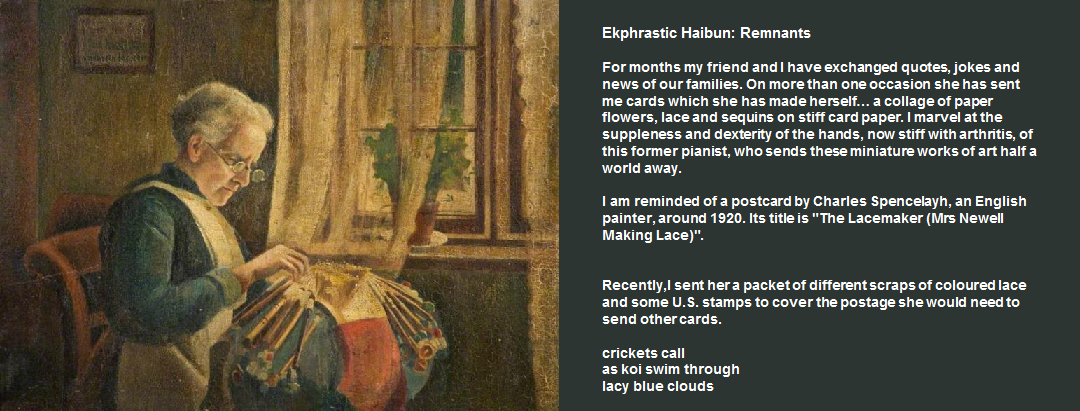
Ekphrastic
haibun: Remnants
By
Angelee Deodhar
For
months my friend and I have exchanged quotes, jokes and news of our families.
On more than one occasion she sent me cards she had made herself… a collage of
paper flowers, lace and sequins on stiff card paper. I marvel at the suppleness
and dexterity of the hands, now stiff with arthritis of this former concert
pianist, who sends these miniature works of art, half a world away.
I
am reminded of a postcard by Charles Spencelayh, an English painter, around
1920. Its title is “The Lacemaker (Mrs Newell Making Lace)”. Recently, I sent
her a packet of different scraps of coloured lace and some U.S. stamps to cover
the postage she would need to send some more cards.
crickets
–
koi swim through
lacy blue clouds
Source: https://miriamswell.files.wordpress.com/2016/10/getpart.png
Braided Haibun
https://contemporaryhaibunonline.com/cho-18-2-table-of-contents/plaiting-poem-prose-by-rich-youmans/
Rich Youman in his
scholarly article ‘Plainting Poem & Prose’ writes the art of braided haibun
( the term introduced by Clare MacQueen). Rich expalins “each line of the haiku can
resonate with the prose” and in writing such haibun the “Braiding can help to
pace the narrative while the haiku subtly infuses it” …. and “can control the
pace of the haiku for greater effect”.
Some poets namely Fay Aoyagi, S.H. Bjerg, Peter Newton, Roberta Beary, Kat
Lehmann, Clare MacQueen, Lorraine Padden, Dian Duchin Reed, Harriot
West, Steven Carter, Kala Ramesh and others excellently experimented this
format. “Confession” by Fay Aoyagi published in the winter-spring 2015
edition of Modern Haiku is the first trial of writing a sort of
braided form of haibun by splitting 3-line haiku and interspersed within prose
section. Both fay and Peter evolved the
form out of sheer fun Fay confesses , “I … just wanted to try something
new,…..” she said. “to break a pattern people have used. . . I just wanted to
say something strange” to surprise the reader. There is a strong literary value
of this parallel blending of prose and poetry.
Confession
by Fay Aoyagi
Rorschach test
His favorite flower is
a white chrysanthemum.
I cut the night
He is the only child,
but says he has many ghost cousins.
with my knife
He confesses that he’s never been comfortable
with his thorns.
I personally enjoy the innovative poetic blending of the haibun, “Vanishing
Point” by Lorraine Padden (autumn 2021
issue, Frogpond ) and “Walking
meditation” by Kala Ramesh.
https://contemporaryhaibunonline.com/cho-18-3table-of-contents/kala-ramesh-walking-meditation/
Walking meditation
by Kala Ramesh.
wary of stepping on insects and
worms, i move with my eyes glued to the earth.
through a bamboo forest
i once saw a group of Jain monks
walking barefoot, their soles barely touching the surface to avoid stamping out
any living being.
the whistling winds bend
the rhythm of life—back home, a
100-legged centipede glides across the backyard.
a piece of music
In an attempt of
verse envelope haibun, Pravat Kumar Padhy tried fusing with ‘One-word’ haiku
interspersed by a micro prose (Drifting Sands Haibun, Issue 13, 2022, Ed. Adelaide B.
Shaw). In her
acceptance email, Adelaide B Shaw comments the micro haibun: ‘A lot of meaning is conveyed in just
a few words.’
https://drifting-sands-haibun.org/2022/01/29/beyond-horizon/
Beyond Horizon
by Pravat Kumar Padhy
dawn
The battlefield fire ... tears fall short of as the silence shrinks with
the shrill of a blackbird.
dusk
In fact, the idea of introducing two one-word verse-envelope
micro haibun came as a flash to me. The one-line prose juxtaposes both one-word
expressions. The emotional feeling and diving into darkness have been
symbolically represented by ‘blackbird’. This is the first time I introduced two
one-word haiku in this micro-haibun. Both ‘dawn’ and ‘dusk’ are of one syllable
each. I feel the one-line prose symbolizes as the backdrop image for both the
one-word haiku to sustain and signify the importance. The prose constitutes a
sort of white space that
inter-weaves the one-word haiku and
imparts meaning to the wholeness. It
threads the micro-poems for juxtaposition in a minimalistic way with a distinct
poetic signature. The above haibun portrays the tragic scene of the battlefield
on the time axis. The silence is metaphorically expressed through ‘blackbird’
with screams and shrill deepening further into darkness.
Recently, based on the concept of ‘Found Poetry’, torrin a.
greathouse , has introduced a sort of prose-poem and named it as “Burning
Haibun” (Frontier Poetry). https://www.frontierpoetry.com/2017/06/16/poetry-burning-haibun-torrin-greathouse/
Haibun
genre witnessed many experiments over time to unfold the literary curiosity of
the poets and flavor for the readers. I recall the philosophical sentence of
the Genjuna International Haibun Awardee, Geethanjali Rajan: “As change is the
only constant, it is exciting to see how haiku and haibun are evolving around
the world.”
Additional
References
Antonovic,
Aurora and Yu Chang , 2009, Jardins Du Luxembourg, Frogpond, 32.2, 2009
https://www.hsa-haiku.org/frogpond/backissues/32-2-Frogpond-SpringSummer2009.pdf
Aoyagi, Fay,
Confession, 2015, winter-spring edition,
Modern Haiku
Bashô,
Matsuo Oku no Hosomichi
http://www.bopsecrets.org/gateway/passages/basho-oku.htm
https://contemporaryhaibunonline.com/chohtmlarchive/pages144/A_Ross_Narratives.html
Tr. Imamura Takeshi and Patricia Lyons,
Published by Noma Minako Matsuyama, Japan 2013
Cain Jack, Paris, Volume 63,
a biannual of poetry, October 1964, No. 2, Board of Publications, University of
Waterloo, Waterloo, Ontario, Canada, pages 32-35
http://www.hsa-haiku.org/meritbookawards/meritbookawards1975.htm
Codrescu , Ion, Rich Youmans, and David Cobb, 2005, ‘from Apricot Tree’, Modern haiku, 36. 1,
2005
https://www.modernhaiku.org/issue36-1/haibun36-1.html
Deodhar,
Angelee, 2016, Ekphrastic Haibun: Remnants
https://miriamswell.files.wordpress.com/2016/10/getpart.png
French Terri L. and Jane Reichhold , 2013, ‘Her Dance Card Full’ 2013 Lynx: A Journal for
Linking Poets, Vol. 28,
No. 3, 2013. (https://contemporaryhaibunonline.com/cho-16-3/terri-l-french-jane-reichhold-her-dance-card-full/
greathouse ,
torrin a.2017, Found Poetry “Burning
Haibun” (Frontier Poetry)
https://www.frontierpoetry.com/2017/06/16/poetry-burning-haibun-torrin-greathouse/
Hansmann,Charles, 2007, THE WHOLE WEST,Haibun Today
http://haibuntoday.blogspot.com/2007/12/charles-hansmann-whole-west.html
Harpeng , Jeffrey, 2008, WHAT IT IS,
Haibun Today http://haibuntoday.blogspot.com/2008/05/jeffrey-harpeng-what-it-is.html
Kacian, Jim, Where I leave off,
2010, one-line haiku and haibun , An electronic version based on the first
printing/1e druk maart 2010, ISBN 978- 94-90607-02-9 https://www.thehaikufoundation.org/omeka/files/original/7e0f3dafee3546b56aa7cc773e5803be.pdf
Krawiec ,Richard , 2008, UNTITLED,
Haibun Today, http://haibuntoday.blogspot.com/2008/09/richard-krawiec-untitled.html
https://www.hsa-haiku.org/frogpond/backissues/32-2-Frogpond-SpringSummer2009.pdf
Lucky,
Bob, 2008, SMALL JOURNEY MEDITATIONS, Haibun Today http://haibuntoday.blogspot.com/2008/09/bob-lucky-small-journey-meditations.html
Mair
Catherine and Patricia Prime, 2009, ‘Chinese Checkers’, Haibun Today
Blog
http://haibuntoday.blogspot.com/2009/08/catherine-mair-patricia-prime-chinese.html
McDonald Tanya and Lew
Watts,2021, Whitecaps
, Contemporary Haibun Online, 2021
https://contemporaryhaibunonline.com/cho-17-2-table-of-contents/tanya-mcdonald-lew-watts-whitecaps/
Michael
Dylan Welch, 2019, Missing the Moon: haikuless haibun, CHO 14:4, January 2019, https://www.graceguts.com/essays/missing-the-moon-haikuless-haibun
Padhy, Pravat
Kumar, 2022, Beyond Horizon, Drifting Sands Haibun, Issue 13, 2022https://drifting-sands-haibun.org/2022/01/29/beyond-horizon/
Pelter,
Stanley , 2006, a hill blows up, 2004,
& Y Not?, 2006
http://haibuntoday.blogspot.com/2007/12/stanley-pelter-hill-blows-up.html
Pilarski
,Patrick M., 2009, Netley Marsh Poems ,Frogpond, 32.2 , 2009
https://www.hsa-haiku.org/frogpond/backissues/32-2-Frogpond-SpringSummer2009.pdf
Ramesh, Kala,2022, Walking meditation, Contemporary Haibun
Online, 2022
https://contemporaryhaibunonline.com/cho-18-3table-of-contents/kala-ramesh-walking-meditation/
Rasmen, Ray, 2009, Day’s End,” Modern
Haibun and Tanka Prose #2, January 2009http://haibuntoday.com/ht72/a_Rasmussen_Modeling.html
Roach, Michael, 2008, A Rude
Awakening, Frogpond, Fall 2008, https://www.hsa-haiku.org/frogpond/backissues/31-3-Frogpond-Fall2008.pdf
Samuelowicz
, Katherine, MOROCCO MAY 2004, Yellow
Moon 16, Summer 2004
http://haibuntoday.blogspot.com/2007/12/katherine-samuelowicz-morocco-may-2004.html
http://haibuntoday.blogspot.com/2007/12/katherine-samuelowicz-his-grandmas.html?m=0
Shirane,
Haruo. Traces of Dreams: Landscape, Cultural Memory, and the Poetry of Bashō.
Stanford, California: Stanford University Press, 1998
https://contemporaryhaibunonline.com/chohtmlarchive/pages144/A_Ross_Narratives.html
Ueda, Makoto. Matsuo Bashō.
Tokyo: Kodansha, 1970, 1982
https://www.kenjoneszen.com/haibun/haibun_an_introduction
http://haibuntoday.blogspot.com/2007/11/jeffrey-woodward-haibun-minus-haiku.html
https://ddsn.com/blog/digital-design-service-technology-quotes/prof-jennifer-doudna.html
Wallace,
J.R. "Reading the Rhetoric of Seduction in Izumi Shikibu
nikki." Havard Journal of Asiatic Studies, Vol. 58, No. 2
(Dec., 1998), pp. 481-512.
http://haibuntoday.blogspot.com/2008/03/insideoutside-stanley-pelter-on-haibun.html
Watts , Lew and Rich Youmans , 2022, The
Horizon’s Curve’, CHO, Issue 16.3, 2022
https://contemporaryhaibunonline.com/cho-16-3/lew-watts-rich-youmans-as-if/
Winke, Jeffrey, , Haibun Today, 2007
http://haibuntoday.blogspot.com/2008/06/jeffrey-winke-without-disclaimer.html
Winke,
Jaffrey, 2008, Haibun Today
http://haibuntoday.blogspot.com/2008/05/jeffrey-winke-bookend-haibun-experiment.html
World
History encyclopedia https://www.worldhistory.org/Izumi_Shikibu/
Youmans,
Rich, 2022, Plaiting Poems & Prose, The Art of Braided Haibun, Contemporary
Haibun Online, 18.2, 2022
https://contemporaryhaibunonline.com/cho-18-2-table-of-contents/plaiting-poem-prose-by-rich-youmans/
Zimmerman,J, Contemporary
Haibun Online, The Waxing Moon by Kurita Chodō
https://contemporaryhaibunonline.com/chohtmlarchive/pages104/Article_Zimmerman_AJapanese.html
https://www.graceguts.com/essays/missing-the-moon-haikuless-haibun
http://haibuntoday.blogspot.com/2008/05/washing-jade-in-muddy-water-bill-wyatt_27.html
Credit: Café Haiku, 19 th January to 23 February 2024 Part 1 to Part 6 (Published in every week)
Subscribe to:
Posts (Atom)