Wednesday, February 9, 2022


Book Review : One Breath Poetry By Neena Singh

Pravat Kumar Padhy POSTED ON NOVEMBER 14, 2021

One Breath Poetry:

Journal of Haiku, Senryu & Tanka

By Neena Singh,

Sambhavna Prakashan, 2020, 168 pages (Hardcover);

ISBN: 978-93-81619-12-4, Price: Rs.300

Neena Singh’s maiden collection of Japanese short forms of poetry, ‘One Breath Poetry” is embedded with poems of varied styles that reward reading. Brief head-notes on haiku, senryu, tanka, and on five seasons with elegant black-and-white monochromatic photographs add beauty to the book. She is influenced by the architect of modern Indian haikuist, Angelee Deodhar and the teaching of the Japanese Buddhist priest, Nicghiren of the Kamakura period. The collection reminds me of the seasonal scenes of Gerald Vizenor’s haiku collection, ‘Favor of Crows”.

She chooses to quote the lines from the Persian poet to reflex true to the title of her book:

The sum total of our life is a

breath spent in the company of the Beloved

-Abu Sa’id Abul-Khayr

Neena decodes the images into the art of words as experienced at different places: Japan, Mauritius, Bhutan, Seattle, Florida to Pennsylvania of America, and the Fragrance Garden of Chandigarh. It reminds me of Basho’s view: the haiku is what is happening at the time in this place.

Her poems often set sights on cats, dogs, frogs, butterflies, bees, bats, squirrels, spiders, seashells, cicadas, pigeons, kingfishers, koels, peacocks, and flora like phlox, tecoma, laburnum, bougainvillea, hydrangeas etc.


She experiences the stages of life through the change of seasons: savor in spring, abundance in summer, revival in rain, a fall or loss in autumn, and finally a sense of solitude in winter.

Spring brings exhilaration as she observes:

so many flowers

in the spring breeze

a butterfly flutters  (p. 18)

When Issa says: “there is no stranger under the cherry tree.”, Neena shares ecstasy by visiting early flowering cherry trees and discovers the strangers smile:

under the tree

early cherry blossoms–

strangers smile  (p. 21)

She blends cultural layers with subtle allusiveness as the moon reveals its sublime presence amongst thick foliage like the leprechaun. The reference of leprechauns in Irish folklore is associated with the fairy in the form of an old man — smoking a pipe, dressed in a leather apron and a hat, and having buckled shoes— who is trailed from the tapping sound of his cobbler hammer.

the full moon

hides in the garden all night:

is it a leprechaun  (p. 37)

She uses literary devices (Epizeuxis, Diacope) of repetition of words to create rhythm and emphasis. Her haiku at places are alliterative in nature as she unfolds the abundance of the summer and senses the sound in the stillness of noon:

sun and sand

burnish skin to gold

an unending summer  (p.66)


noon stillness

broken: feisty crows scratch

the wooden bench  (p. 57)

The fading away of ducks after sunset, “Green lake Park /ducks paddle and fade/ into the sunset” (p. 65), is a captivating visual snapshot by the poet. Interestingly the impression resembles that of Basho’s magical creation:

The sea darkens/ and a wild duck’s call/ is faintly white

Her poetic reflections corroborate with the life-related aspects. The reference of ‘revival’ during the rainy season is aptly captured in one of her haiku:

after the downpour

garden choir – in crescendo
frogs and cicadas  (p. 74)

She is a believer in complementary nature (yin-yang). Metaphorically, through the shades of autumn, she explores the sanity of life. It is beautifully crafted in the form of fallen leaves with philosophical allusion.

back to earth

by a gardener’s broom–

dry leaves crackle (p. 90)

She recounts her family association and embraces solitude. Her literal allusion tracks the path to a solemnized end. She says in her introductory note on haiku: “It expresses the wonder of Nature and the seasonal changes, a love for life, and at times,  deep thoughts…..composing haiku is a path- a way of observing life and catching the ephemeral with brevity … ”

leafless trees

draw on the skyline
a charcoal sketch  (p. 110)


bony arms

hold the sky

life’s winter  (p. 122)


mother’s story

remains half-told

half-moon night   (p. 137)

Reconciling the reality, she wishes to stay calm and often finds solace through humour:

a piece of my heart

in grandson’s laugh

—aping T-rex  (p.132)


barefoot again –

the dog asleep

on my slippers (p.141)

Faith, love, emotion, and philosophical penchant have been reflected in her tanka.  She derives zen-feeling when she visits places of pilgrimage in Tokyo and expresses her deep reverence for lotus sutra ‘Nam-myoho-renge-kyo’. She cherishes the flourishing life of her companion. With time gone by, stepping into the world of solitude and melancholy, she inks:

an acorn, a red leaf

reminders of our walks together

when you said “hurry”

hands in pocket, touching them

I walk alone today…  (p.154)

The metrical exhibition, imaginative blending, and lyrical exposition are embedded in her tanka as she portrays both joy and anguish:

the long wait over

my son becomes a father

hugs his son skin-to-skin

oceans apart, grandma’s  heart

misses a beat to connect forever  (p. 155)

The collection is painted with hues of nature and a touch of intimacy. The book is worth preserving in the personal shelf of haikai compendium.


Publication: Rhyvers, Nov 2021

https://rhyvers.com/one-breath-poetry/


Author

Pravat Kumar Padhy


Pravat Kumar Padhy holds a Master of Science and a Ph.D from Indian Institute of Technology, ISM Dhanbad. He is a mainstream poet and a writer of Japanese short forms of poetry.  His poem “How Beautiful” is included in the undergraduate curriculum at the university level. Pravat’s haiku own The Kloštar Ivanić International Haiku Award, Vancouver Cherry Blossom Festival Invitational Award, IAFOR Vladimir Devidé Haiku Award, Setouchi Matsuyama Photo Haiku Award and others. His haiku are featured at Mann Library, Cornell University and tanka is figured in “Kudo Resource Guide”, University of California, Berkeley. Pravat is nominated as the panel judge of ‘The Haiku Foundation Touchstone Awards’, USA and he is on the editorial board of the journal, ‘Under the Basho’.


Thursday, February 3, 2022


 Beyond Horizon

dawn

The battlefield fire ... tears fall short of as the silence shrinks with the shrill of a blackbird.

dusk

Drifting Sands Haibun, Issue 13, 2022 (Ed. Adelaide B. Shaw)

https://drifting-sands-haibun.org/01/2022/beyond-horizon


children cross one bridge and the other migratory birds

Whiptail, issue 2: 2022 (Eds. GRIX and Kat Lehmann)

https://www.whiptailjournal.com/issue-2-migrations-and-destinations.html

Saturday, January 29, 2022


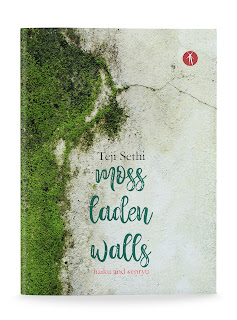
 Moss Laden Walls: A Review

 by Dr. Pravat Kumar Padhy

​

By Teji Sethi, (Hawakal Publishers, 2021). 107 pages; ISBN: 978-93-91431-05-1. Price: Rs. 350, USD 14.99, Available on Amazon


Teji Sethi is a bilingual poet and anthologist. Her haiku are often illustrated by the sense of wabi-sabi (aesthetics of natural simplicity and solitude). She is emotional and the memories strike the note in her poems:


moss-laden walls her fingers trace remnants of the past (p. 9)


It reminds me how closely it makes a poetic parallel with the haiku written by Gabi Greve: mossy steps overgrown by time and loneliness

​

She has intelligently engaged the sense of touch, sight, smell, sound, and taste:

​

autumn breeze …

her forehead still moist

with the parting kiss (p. 12)


Creativeness and contrast imageries have been often enamored as poetic metaphors when she presents:


Ganga aarti …

a million suns

sink into darkness (p. 18)


She often blends science with poetic symbolisms when she awaits the rhythm of the moon and tides:


new moon

the stillness of sea

awaits a tide (p. 37)


She is bold, evocative, and paints womanhood with sharp contrast:


menopausal blues

it is not

         red always ( p. 45)


She is equally brilliant in crafting senryu with a touch of wit and human attributes:


shelling peanuts

neighbours once aggrieved

share a gossip (p. 43)


therapy session

with her autistic son

she learns to tie a lace (p. 53)


Teji writes haiku with lightness (karumi) and elegance (fuga). She articulates vividness through the art of juxtaposition.


mango orchard

the planter sings back

to the cuckoo (p. 49)


origami swans …

father shares

it is time to depart (p. 89)


migratory birds …

carrying home

a piece of sky (p. 91)


She has also tried a 4-line haiku (haiqua): bus ride … / waving at a friend/ I grab/ a handful of wind (p. 81) and an experimental vertical array in the haiku on pandemic (p. 87):


tree sap the life in quarantine d me out

                                        r

                                        a

                                        i

                                        n

                                        s


Teji recalls the trauma of partition of India in haibun, ‘Tapestry’ and ‘Fragments’. The tanka prose ‘The Road Not Taken’ is a brilliant piece of reminiscence. She enumerates the contrast between the crowded modern city and the serene silhouettes of the mountain range. The concluding tanka manifests the ‘dreaming room’ (to quote Dennis M. Garrison). a beam of moonlight sieves through the window … the mesh of relationships I have lived all these years


When she writes, “a tender plant/ pushes through the cracks/ cemetery” (p. 21), I recall the ray of optimism portrayed by Issa:

​

moss blossoms

blooming a little crack...

stone Jizo 

​

Kobayashi Issa (Tr. David Lanoue)

Publication: triya Magazine, 2021

https://www.thetriyamag.org/general-8

Saturday, January 15, 2022

Dwelling with Denial: A Collection of Poems by Rajiv Khandelwal

ISBN: 978-93-89213-19-5, The Poetry Society Of India, 2020 p. 130

 Reviewed by Pravat Kumar Padhy, Poetcrit, July 2021

Rajiv has a unique way of writing poetry manifesting the contemporary structural fabric. He is spontaneous to express the inner feeling and his poetry often forms a dialogue-style with words of frankness. In the present collection, ‘Dwelling with Denial’, he has portrayed broadly the topics related to social issues with political satires at places. Some of his poems included in the collection broadly sketch the poet’s urge for love and carry the glimpses of sensual streaks. He is often optimistic in his approach and occasionally dwells in the cradle of pessimism. Perhaps he wishes to put the point of view straight and forthwith as has been observed with uneven line breaks and without any punctuation.

Similarly, the persistence of socio-political and socio-economical evils frustrates him and compels him to dwell in spite of strong resistance. This might have led the poet to appropriately title the collection of verses.  Towards the end, he engages himself composition of analytical poetic exhibitions about the poet, poetry, and its content.

Interestingly, Rajiv has tried to use poetic devices in an artful style. The use of word-phrases, sound repetition, similes, metaphor, and allegorical expressions has added beauty to the collection.

He has used beautiful and stimulating words as ‘like evaporation of faith,’ ‘blind person’s yearning for eyesight,’   ‘As silent as our shadows,’ ‘Baggage of thoughts,’ ‘arsenic eyes,’ ‘Ice-hard resolutions,’ ‘As dry as the desert sands,’ ‘clothes of understanding,’ ‘quicksand of crazy,’ ‘corrosive thoughts,’ ‘wide-eyed realization,’ ‘thick fog of lust,’ ‘thirsty tree leaves,’ ‘keening cry,’ ‘Tongue-tied.’ Indeed these are worthy examples to contemporary literature.

Poetic craftsmanship and the use of figures of speech have been often observed in his poetry with nuanced techniques. The use of similes such as “Our eyes locked/ Like insects in amber”  (‘Another Wait’); “Like the whisper of a sleeping child”  (‘Call You Later’);  “That I missed her/ Like fish missing water……Like parched earth missing/ Raindrops/ In rain forests” (‘In Rain Forests’). At places, Rajiv uses

musicality with the use of alliteration like ‘stern signature stare,’ ‘prying pedestrian peek,’ ‘unwisely unafraid, clock’s click clack’ etc.

Occasionally he has crafted a few metaphorical articulations such as: 

In my life

She is the cloud

Without which there can be no rain      (‘My Wife’)


 And my thoughts

Roam aimlessly like a typical window-shopper       (‘Wandering Thoughts’)

Rajiv is forthcoming in his expression with poetic diction as observed in the poem, ‘Petition’. The textual fabric of expression in the poem demonstrates a distinct literary accomplishment as he appeals with optimism in spite of all odds:

Requesting a stay order

On the cancer gnawing away my vitals 


Today, the red flag from the doctors

Revealed

My petition has been rejected

The gods have not commuted the death sentence

……………………..

……………………..

Bring faith and joy 

As I wait

Hot, wet and not weary

To give you pleasures

Beyond measures 

Come before the glass hour sands drop down

Terrorism and heinous disturbances have been sketched in some of the poems. He is very much disturbed by the plight of ‘Pulwama’ attack and condemns the dreadful act by the terrorists:


I have  

Against the vulture

That sweeps down my garden

Every afternoon

Since “Pulwama” attack


While it ought to be dive bombing


With its flock

To feast

Across the LOC          (‘To The Pilots Who Visited Balakot’)


The poet engages himself in the corridor of love as observed in the poem, ‘Another Wait’, ‘Union’, ‘Dear Mate’, ‘A Dilemma’, ‘Call You Later’, ‘When She Is Around’, ‘The Suckables’, ‘Her Hands’, ‘A Backward Glance’, ‘My Darling’, ‘The Rain Forests’. The love poems are expressions of more visual manifestation and prosaic narration. Sometimes the images are infused with poetic elusiveness. The poet paints the touch of sensual feeling through crafted style:

The fourth ring

Satisfying to the mind as water to thirsty lips

Came like the bride carrying thoughts of budding love     (‘Call You Later’)


The sound of her voice

Her facial features

Her youthfulness

Her curves                             

               All a magic ticket

                                        A spy-hole into dreams   (‘When She Is Around’)

 Thoughts

That fed of each other

                                 Let loose


Were up all night

Painting the town red   (‘Her Hands’)

The poet is very sensitive to the prevailing social issues. He described the heinous plight of human trafficking, the painful life of the victim, and her expression out of anguish in the poem, ‘Pain Desiring Understanding’. 


Let your mother, sister, daughter

Or say your wife

Let them just merely imagine

Living my life, a single day

Like a piece of meat


Only then, dare to   

Point moral compass towards us 

He has carefully touched the poverty, socio-economic, socio-political, and religious aspects in the poems like ‘The Debt’, ‘Dwelling with Denial’, ‘Guilty’, ‘Echo’, ‘The Kick’ and ‘Life As Usual on This Road’.


In the poem, ‘The Kick’, the poet allegorically portrays the contemporary images corroborating the social issue. It is a masterpiece of socio-sensibility.

The pothole

Took the kicks

Silently and with surrender

Just like the untouchables

Taking it

Since ages 

In the poem, ‘Life As Usual on This Road’ he portrays the road in a metaphorical sense and depicts the images of social condition:

 This was common place

It was life as usual on this road

 ‘Leave Some Words Unsaid’ is a poem that has quite similar in style to Ezekiel’s  ‘Goodbye Party for Miss Pushpa T.S.’ The emotional expression has been depicted in the verse:


Dear All

Let us leave some emotions and feelings unexpressed

Some words are best left unsaid                          

For no words can express how much you mean to us

May God bless you and make you ageless       

He laments the persistence of evils in society and portrays satire in his poem, ‘The Poem Unborn’. It is an eye-opener for all responsible citizens to rebuild society with modesty, decency, and mutual respect.

But each night

The unfinished tired poem


Goes to bed

With the pen


To wake up once again

To the same mundane routine

Childhood memories in the close-knitted family have been vividly narrated in verses like ‘Mother in Our Joint Family’, ‘Preschooler’s Conversation with Granddad and others. In the poem, ‘Destination’, the poet recalls childhood school and its plight in the complexity of modern life.

In the poem, ‘Critical Comments’, he concludes the verse with the touch of emotional childhood reminiscences:


“Nana – you do not know how to tell a story

I am leaving

                 Nani is better ”

His narration in the poem ‘Mother in Our Joint Family’ is heart-touching. He emotionally scripts:

When will I

Have the landscape of my mind   

Colored green

And do

What you do

Without complaints?   

He is good at unveiling the club-culture and extravaganza through satire by comparing it with modern jean-design and beggar’s cloth to reflect the prevalence of the contrasting societies as reflected in the poem, ‘Pleading in a Dubai Club’ and ended with a carelessness under the influence of modernity.

Some in designer slit jeans competing with a beggar’s clothing

……………….

……………….

Don’t-care-who-watches-me

Opening back to youth


Escapism

             Oxytocin released

Had unbridled fun

Until the small hours of the morning

Similarly how the use of modern gadgets, social sites have isolated everyone has been depicted in the poem, ‘Dreamy Expectation’.

 He wishes poetry to be a language of all entities and it needs to connect with the readers for better communication to build a tangible base.

And the magic of language compressed

Endlessly scrutable

Becomes a living entity

                                  Syllables and sutras come alive    

Connect

Grow within the reader     (‘A Successful Poet’)


Memories

Are familiar companions

A part of our lives

……………..

……………..

Emerging out of the blue

Through individual words

Picks and puts them next to one another

And the words fit in

Like bricks in their mortar base    (‘Poem-The Arrival’)

He defines the assimilation of self and the essence of the poem for crafting the elusive poetic insight.

And finds his own self

In the poem’s narrative

Then the poem

Can honestly claim

To be owned and understood     (‘Poem’s Claim to Lucidity’)

 Interestingly use of Indian cuisines in the Hindi in the poem titled  ‘Idée Fixe’ (meaning ‘Idea fixed’ in the French) is an interesting narration.

The vivid imageries created in the collection about the striking socio-economic aspects are worth reading and are stepping stones for reformation. Poetry on dreaming for love is a distinct addendum to contemporary literature having a touch of humour. The structural aspects of a few poems seem a bit didactic and prosaic in expression and the content of a couple of poems could have been modulated to resonate better poetic rhythms.


In the complex world, the poet tries to reconcile himself to the situation and leads a life assimilating the denials and obstructions. Appropriately he has coined the title of the collection,‘Dwelling with Denial’.

Bias and rejection

Have corroborated

To assure, we

The doubly disadvantaged

Be destined to dwell with denial 


*****   *****   *****   *****


Saturday, January 8, 2022


Voices: Poverty in Haiku

Tony Pupello

I believe the most insidious and least examined of all the adverse effects upon the human condition are the effects that a state of poverty can have. Not, mind, a state of self-imposed abstinence or self-denial, or a kind of “hitting the road, come what may” attitude. This is based on conscious choice – I choose not to have material possessions, or I choose to live very modestly and without very many.

Abject poverty, in my view is, precisely, a lack of choice. In a state of abject poverty there is no choice; there are no options. Without options, one finds oneself (or a family finds itself), trapped, a victim to whatever winds are blowing.

This essay is an attempt to begin to look at abject poverty in haiku.

At the outset, in preparing for this essay, let me say I have done a great deal of research and I owe a debt of gratitude to Jim Kacian for sharing his Red Moon Anthology resources of over 20 years; and to Dee Evetts as someone who has been collecting work on issues of social justice for just as long. I am pointing this out for two reasons; first, of course, is to acknowledge the debt; second, however, is to point out as this is no small collection of resources – in addition to my own collection of journal issues and chapbooks dating almost 40 years – I was struck by the dearth of haiku dealing with poverty. There are many, many pieces dealing with war, the environment, politics, etc., all issues of social justice – yet there have been strikingly few pieces dealing with the issue of poverty directly.

We have heard social scientists speak of “middle-class values”. Lately, there has been a lot of talk regarding “entitlement” – especially as regards racial politics. I contend that “entitlement” is a real phenomenon not predicated upon race, per se – but upon class. This is not to dismiss by any means the notion of entitlement based on race – this is all too real. But it is to highlight that poor people, really poor people, poor folk of any race, creed or color – have a different mind-set and a value system that is simply not middle-class. A person with middle-class values has the expectation that there is some kind of something due them. They don’t have to “ask permission”. A poor person, one without middle-class values, is constantly questioning whether anything is due them – even that which they have earned. They must “ask permission” as it were because nothing is ever due them.

Quite some time ago, as a student of political philosophy, I came upon a radical, female, black feminist political theorist who wrote under the name “bell hooks”. Well, I won’t even try to approach what I know/do not know about being female or a feminist; nor will I even try to approach what I know/do not know about being black – so, I can say that bell hooks did not speak directly to me in her female, feminist nor black voice. However, in quite a number of her books and essays – of which there is a substantial body of work – she spoke very clearly and undeniably to me in a voice I immediately recognized. She spoke to me as someone who had known true poverty; she spoke to me in that inescapable “poor voice” I knew all too well. She spoke to me in her birth voice, with her birth name – “Gloria Jean Watkins” – and as Gloria Jean Watkins her communication was plain, direct and very, very real and intelligible to me. So, too, the piece below by one of the most famous American authors of the 20th Century speaks to me.

             I am paying rent
             For the lice in my cold room
             And the moonlight too.

As many who wrote English-language haiku in the “very early days”, Richard Wright followed the conventions of syllable count, capitalization and a final period. This piece, from someone who knew first-hand the sting of poverty, exhibits a great deal of detachment and restraint. Of course, it also shares the irony many poor people contend with – actually a double-irony, as it were. The flat is cold and lice-infested. One has to be constantly on guard against lice – once infected they bite incessantly and can be maddening in no small measure. Here in a “poor voice” Wright speaks to the bitter irony of having to pay not only for the cold but for the lice as well. Bitter as it may be, perhaps he realizes he at least has the money to pay for a roof over his head. In a more poetic turn, there is the Zen-like irony of the beautiful moonlight being shared in the room as well.

The next two poems speak to the direst of poverty situations – literally losing a roof over one’s head – that of eviction itself. The first is by Charles B. Dickson, the second by Stephen C. Curro.

    evicted hooker:            eviction notice
    her mattress              my daughter asks
    at the curb              about dinner

Perhaps one of the most horrible effects of poverty is an actual eviction – second only to the fear and anxiety that an eviction notice might produce. In many cases an eviction notice – usually heralded by the big, bold, title “Notice of Eviction” – includes language that a tenant is “dispossessed” by a landlord – literally a landlord removes “possession” of a dwelling from that tenant. Imagine the fear of being dispossessed – literally to be deprived of a living space that never truly was yours to begin with.

Dickson’s piece hinges on the hooker’s mattress. Indeed, if one were cold-hearted, one might even get a chuckle at this piece. Clearly, there is a great deal of complexity in focusing on the mattress. While I choose to believe it was not Dickson’s intent to provoke any sort of humor at all, I do wonder if, looking from the outside, does he feel/know the hooker’s sense of fear and abandonment and, yes, perhaps even shame? Whether intended or not, Dickson’s piece works on yet another, much deeper level – not only is the hooker dispossessed of her dwelling but, in the embodiment of the mattress, she is also dispossessed of the means of her livelihood. This raises another set of issues, the lengths to which folks might go to avoid poverty – in this case the notion of selling oneself outright – but that might be a topic for another time.

Curro’s piece seems to me to be coming much more from the “inside” as it were. Here is a parent, clearly in dire straits, forced into having to contemplate his family’s being moved “out on the street” as it were. In addition to worrying about clothing, bedding, furniture and all other familial and meager possessions being out on display – right there on the sidewalk for all neighbors and passersby to see – to be witnesses to the family’s shame and humiliation – he is also confronting a more immediate threat as well – “my daughter asks/about dinner.” We can only hope this is an everyday distraction that points to the daughter’s innocence, her naivete, her lack of knowledge of impending doom. We can only hope the father is juxtaposing the horror of an eviction notice with the commonplace query of a child “what’s for dinner” or “when is dinner”. However, in a more ominous vein, I think this may not be the case. It seems to me the father is confronting the immediate horror of hunger as well. Going, ofttimes for days, without food – not out of choice because one is fasting or trying to lose weight quickly – but because one is, again, without choices. Feeling the emptiness in the pit of your stomach that goes on and on without ending because there is, simply, no food to eat and no money to purchase any food with. How does a parent explain this to a child? And how does that child understand it? And how does eviction and hunger shape that child’s perspective later on?

In the next two pieces, by Sanjukta Asopa and Curtis Dunlap respectively, dwelling and hunger are again under consideration.

    shanty town —              recession —
    the jagged edges              poke salad growing
    of moonlight               in a sidewalk crack

In our haiku/senryū universe we often invoke moonlight in a setting of harmony. In Asopa’s piece, however, the jagged moonlight is a reflection of the uneasiness of living in a state of squalor – both literally and figuratively. One can actually picture moonlight reflecting off of uneven pieces of roofing – various metals, plastics, found materials – that are arranged in various lengths, sizes and angles.

Although it may have medicinal purposes, how many of us would actually eat a “weed” or something that is grown literally in sidewalk cracks? In Dunlap’s piece, the pokeweed, which would literally be growing out of sidewalk cracks, is already transformed into poke salad. For many poor folk, recession or not, a poke salad may help fill their bellies, may help in their sustainability. This reminds me of the harvesters of the ginko nuts that fall onto city sidewalks right here in New York City. At least in their outward appearance, these folks look as though they could use a meal supplement and would not be found shopping at Whole Foods nor the like.

I would like to close with an offering from Pravat Kumar Padhy.

             long walk —
             the slum boys stare at
             the distant stars

We can choose to look at this piece as one in which a lack of options is what is and will never change. The slum dwellers, boys really just starting out in life, face a “long walk” – a hard road if you will. They have probably already experienced the harsh reality of what their lives will be. And the stars, beautiful as they may be, are distant and totally out of reach. Perhaps this is the reality.

I choose to look at it in another light – in spite of the lack of choice and options found in a state of abject poverty, there is one thing that poor folk cling to – unless they succumb to utter despair – hope. Yes, the road may be long and hard and, yes, the stars are distant. But there is undeniable beauty in the stars and since time immemorial the stars have been symbolic of something greater and with more possibilities than ourselves. I find hope in this piece.

“When you Wish Upon a Star” was a very favorite of a woman who lived most of her life in poverty yet never succumbed to despair. But that is for another time.

Publication Credit: tsuri door, Issue #7, Jan-Feb 2022

https://tsuridoro.org/voices-poverty-in-haiku